New York State Agencies
Welcome to the most comprehensive and up-to-date online directory for New York State agencies. This website was created to provide you with accurate, verified, and complete information about every government agency in the State of New York. Whether you’re a resident, business owner, researcher, or visitor, our directory offers full access to essential contact details and agency services across the Empire State.
Our New York State agencies directory includes detailed listings for each department and office—featuring official addresses, phone numbers, fax numbers, mailing information, email contacts, and official website links. We also provide tools for agency name lookup, contact number verification, and public record search to ensure you are getting the most reliable and current data available. Users can search for state departments, commissions, boards, and administrative divisions by name, function, or location. From the New York Department of Motor Vehicles and the New York State Department of Health to the New York Department of Labor and Education Department, we cover all major and minor agencies that serve the citizens of New York.
About New York State
New York State, located in the northeastern region of the United States, is one of the most iconic and influential states in the country. Known for its rich history, cultural diversity, and globally recognized landmarks, New York offers an unparalleled blend of urban energy, natural beauty, and historical significance. While many people immediately think of New York City, the state as a whole—often referred to as “New York State” to distinguish it from its largest city—features a wide array of attractions, landscapes, and communities that make it one of the most dynamic places in America.
New York is home to more than 20 million residents, making it the fourth most populous state in the United States. Approximately 44% of the population resides in New York City, while another 40% live on Long Island, a region known for its coastal charm, upscale communities, and beaches. With a total area of 54,556 square miles (141,300 square kilometers), New York ranks as the 27th largest U.S. state in terms of land mass, offering a mix of bustling cities, sprawling suburbs, mountainous regions, and quiet rural areas.
The state’s most famous city, New York City, is located in the southeastern part of the state and is made up of five boroughs: Manhattan, Brooklyn, Queens, The Bronx, and Staten Island. Manhattan, in particular, is known for its world-renowned attractions including the Empire State Building, Times Square, Central Park, and Wall Street. The Brooklyn Bridge, an architectural marvel, connects Manhattan to Brooklyn and is a symbol of New York’s rich industrial heritage. Nearby, the Statue of Liberty stands proudly in New York Harbor as a symbol of freedom and democracy.
Outside of the city, New York State boasts impressive natural landmarks and scenic destinations. In the western part of the state lies the majestic Niagara Falls, one of the most powerful and visited waterfalls in the world. The upstate region is home to the Adirondack Mountains, Finger Lakes, and Catskill Mountains—offering outdoor enthusiasts a wide range of recreational activities year-round. To the east, Long Island stretches out into the Atlantic Ocean and features popular vacation spots such as the Hamptons, Montauk Point Lighthouse, and Fire Island.
Geographically, New York is bordered by several U.S. states and Canadian provinces. It shares its southern border with New Jersey and Pennsylvania, while to the east, it borders Connecticut, Massachusetts, and Vermont. Additionally, it has a maritime border with Rhode Island off the coast of Long Island. To the north, New York shares an international border with the Canadian provinces of Quebec and Ontario, making it a critical gateway for cross-border commerce and tourism. Whether you’re interested in world-class cities, historic landmarks, coastal retreats, or mountainous adventures, New York State has something to offer everyone. From the bright lights of New York City to the tranquil forests of the Adirondacks, the Empire State remains one of America’s most visited, most diverse, and most iconic regions.
New York Official Government Website
New York State Governor
New York COVID-19 Updates
New York COVID-19 Vaccine
New York History
New York State Archives
New York State News
New York Tourism
New York State Counties
New York State Facebook
New York State Twitter
New York State YouTube
NYS Flickr
NYS Instagram
New York Flag
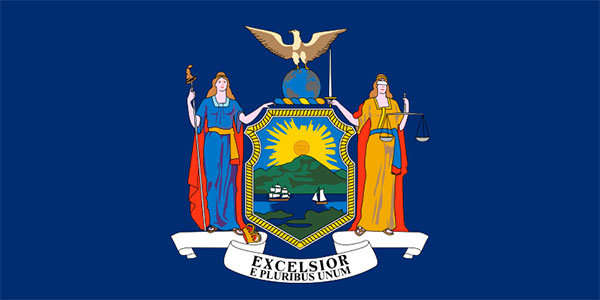
The official flag of New York State is a powerful symbol of the state’s history, geography, and ideals. It features a rich design centered on the coat of arms of the state of New York, which was officially adopted in 1778. The New York coat of arms prominently appears on both the state flag and the official state seal, serving as a long-standing emblem of state identity and pride. The flag’s background is a deep dark blue field, signifying vigilance, justice, and perseverance.
At the heart of the New York State flag is the shield, which depicts a tranquil yet symbolic natural scene. A masted ship and a sloop sail side by side on the Hudson River, reflecting the importance of commerce and navigation to New York’s growth and prosperity. These ships represent inland and international trade, both of which have historically played a major role in establishing New York as a global economic powerhouse. The river is flanked by grassy shores and majestic mountain ranges, and in the background, a rising sun with a smiling face emerges—symbolizing hope, renewal, and the dawn of a bright future for the state and its citizens.
The coat of arms of New York is supported by two allegorical figures that add deeper meaning to the design. On the left stands Lady Liberty, who holds a pole topped with a Phrygian cap, symbolizing freedom from tyranny and the pursuit of liberty. At her feet lies a discarded crown, representing the rejection of British monarchy after the American Revolution. On the right stands Lady Justice, blindfolded and holding a sword and scales, representing impartiality and the rule of law. Together, these figures embody the foundational values of freedom, justice, and democracy that guide the governance of New York State.
Beneath the central image is a white and gold banner bearing the Latin word “Excelsior,” which means “Ever Upward.” This enduring New York State motto reflects the state’s forward-thinking spirit, commitment to progress, and ambition to lead in all areas—whether in culture, innovation, economy, or civic life. In 2020, the state added “E Pluribus Unum” (“Out of Many, One”) to its official seal to further emphasize unity and diversity, although it does not yet appear on the flag itself. The New York State flag has remained largely unchanged since its inception in the 18th century, with only minor modifications made to improve the clarity and precision of its elements. It remains one of the most meaningful and symbolically rich state flags in the United States, representing not only the unique geography and history of New York but also its values and aspirations. From government buildings and public schools to major civic events and parades, the New York flag is proudly displayed across the Empire State as a timeless emblem of state pride.

New York State Facts
Discover the most important and fascinating facts about New York State, one of the most iconic, influential, and diverse states in the United States. Often referred to as the Empire State, New York is located in the northeastern region of the United States and is renowned for its cultural landmarks, economic power, natural beauty, and historical significance.
New York is the fourth most populous U.S. state, with over 20 million residents, nearly half of whom live in New York City, the largest city in the nation. The state is geographically diverse, encompassing bustling urban centers, picturesque mountain ranges, scenic lakes, and world-famous landmarks such as Niagara Falls, the Statue of Liberty, and the Adirondack Mountains. With a total area of over 54,500 square miles, New York offers everything from major metropolitan life to peaceful rural escapes.
Want to learn more? Watch the educational video below to explore more New York State facts, including its geography, history, state symbols, population statistics, government structure, and economic strengths:
In this video, you’ll gain a deeper understanding of what makes New York State so unique—from its founding in 1788 to its role in American history and its continuing influence in areas such as finance, media, education, tourism, and technology. Whether you’re a student, a traveler, or a resident looking to brush up on your knowledge, this video is a great place to start.
New York Agencies
Explore essential information and services offered by key New York State government agencies. Each agency below plays a vital role in serving the people, businesses, and communities across the Empire State. From business registration and labor laws to healthcare and public safety, these agencies help shape and maintain the infrastructure of New York’s state government.
New York Secretary of State
The New York Secretary of State, commonly referred to as NY DOS, is one of the most crucial administrative offices in the state. The department is responsible for a broad range of governmental services, including business entity filings, corporation and trademark registration, notary public licensing, real estate licensing, and lobbyist registration.
The New York Department of State Division of Corporations plays a central role in facilitating economic activity by managing the incorporation and regulation of businesses operating within the state. Additionally, this office plays a key part in maintaining public records, administering campaign finance disclosures, and ensuring compliance with lobbying laws. Contrary to some misconceptions, the Secretary of State is not the chief elections officer (that role belongs to the State Board of Elections), but NY DOS remains integral to overseeing legal and commercial frameworks that support government transparency and economic growth.
New York Department of Labor
The New York Department of Labor is the primary agency responsible for enforcing labor laws and promoting employment opportunities across the state. Its mission is to improve the lives of workers, strengthen businesses, and support the overall economy through job creation, workforce training, and unemployment insurance services.
Through various programs and initiatives, the NY DOL assists workers with job searches, employee rights protection, wage enforcement, career advancement resources, and safety regulations in the workplace. For businesses, the department provides guidance on labor law compliance, tax credits, and workforce development partnerships. Whether you’re an employee seeking workplace protection or an employer navigating labor standards, the New York Department of Labor is a central resource.
New York Medicaid
New York Medicaid is a comprehensive healthcare assistance program designed to help low-income individuals and families access critical medical services. Administered by the New York State Department of Health, Medicaid is jointly funded by the state and federal government and serves as a vital lifeline for millions of eligible residents.
The New York Medicaid program covers a wide range of healthcare services, including primary care, hospitalization, vision and dental care, prescription medications, mental health services, and preventative care. This program supports vulnerable populations such as children, pregnant women, individuals with disabilities, and seniors. Applicants can apply online or in-person through the New York State of Health Marketplace, which helps determine eligibility and guides users through enrollment.
New York State Department of Health
The New York State Department of Health (NYSDOH) is dedicated to protecting and advancing the public health and wellness of all New Yorkers. This state agency designs and implements public health policies, monitors disease outbreaks, regulates healthcare facilities, and provides resources for healthy living.
The mission of NYSDOH is to prevent disease, promote health equity, and ensure access to quality medical care across the state. It oversees everything from immunization programs and environmental health initiatives to nursing home inspections and emergency medical services (EMS). NYSDOH also plays a central role during public health emergencies such as pandemics, offering guidelines, data, and resources to the public. For both residents and healthcare providers, the department is a crucial source of trustworthy and up-to-date health information in New York State.
New York Secretary of State Business Search
The New York Secretary of State Business Search is an online tool provided by the Division of Corporations within the New York Department of State. This valuable resource allows the public to search and retrieve detailed information about registered businesses and corporate entities operating in New York State.
By using the New York Business Search tool, users can access official records including the legal name of a business, DBA (doing business as) names, filing date, status, registered agent, principal office address, and the stated business purpose. This search tool is commonly used by attorneys, entrepreneurs, investors, and members of the public to verify a company’s legitimacy, research corporate history, or obtain documentation required for legal and commercial purposes.
Accessing and verifying business data through the NY Secretary of State online portal enhances transparency, promotes fair commerce, and helps protect consumers and stakeholders alike.
New York DMV
The New York Department of Motor Vehicles (NY DMV) is the state agency responsible for all driver and motor vehicle services throughout the state. With numerous field offices and online services, the NY DMV manages the issuance of driver’s licenses, learner permits, state ID cards, vehicle titles, and vehicle registration. It also oversees the administration of driving tests, motor vehicle inspections, and renewal services.
Beyond just licensing and registration, the New York DMV enforces traffic laws, manages driver safety programs, and provides services related to insurance compliance, emissions standards, and ticket resolution. It is a vital agency for residents, commercial drivers, and new arrivals to the state. You can schedule DMV appointments, check the status of your license or registration, and access hundreds of driver-related resources through the official NY DMV website.
New York Department of Financial Services
The New York Department of Financial Services (DFS) is the regulatory agency tasked with supervising and monitoring financial institutions, banks, insurance companies, mortgage brokers, and other financial services providers operating in New York State. The department ensures these entities operate ethically, transparently, and in accordance with New York law.
The DFS protects consumers through education, complaint resolution, enforcement of financial regulations, and by promoting the stability of the financial system. It offers a consumer portal for filing insurance complaints, verifying licenses, and accessing resources on fraud prevention, cyber security, and financial literacy. The DFS is also responsible for approving insurance rates, investigating insurance fraud, and overseeing emerging sectors like cryptocurrency and fintech.
New York Board of Nursing
The New York Board of Nursing (NY BON) operates under the New York State Education Department and is responsible for the licensing, regulation, and discipline of nurses and nurse-midwives across the state. Its mission is to protect the health and safety of the public by ensuring only qualified, trained, and competent individuals practice nursing in New York.
NY BON establishes educational requirements, evaluates licensure applications, administers disciplinary actions, and investigates complaints of misconduct or impairment. The board monitors compliance with the Nurse Practice Act and collaborates with nursing programs to ensure consistent training standards. Whether you are applying for a nursing license, renewing your credentials, or checking disciplinary records, the New York Board of Nursing is your authoritative resource.
New York State Education department
The New York State Education Department (NYSED) oversees the state’s public education system from pre-kindergarten through college and professional licensure. NYSED sets academic standards, administers state assessments, certifies educators, and funds school districts. Its mission is to raise student achievement, promote equity, and prepare all students for college, careers, and lifelong learning.
In addition to managing K–12 education, NYSED supervises public libraries, higher education institutions, vocational training programs, and professional licensing boards. The department plays a key role in developing policy, curriculum frameworks, and support services for students with disabilities, English language learners, and other underserved populations.
New York Department of Taxation
The New York State Department of Taxation and Finance administers the collection of personal income taxes, corporate taxes, sales taxes, excise taxes, and other state levies. It is responsible for ensuring tax compliance, issuing tax refunds, conducting audits, and educating residents and businesses about their tax obligations.
The department also processes business registrations, enforces tax law, and offers tools for filing returns, making payments, and verifying tax accounts online. Its mission is to collect revenues efficiently and fairly while promoting voluntary compliance and supporting New York’s economic growth.
New York Vital Records
New York Vital Records is the centralized state system for collecting, preserving, and distributing official records of births, deaths, marriages, and divorces. Managed by the New York State Department of Health, this office maintains certified copies of documents that are required for legal identification, citizenship, insurance claims, and family history research.
The office ensures secure access to vital statistics, both for individuals and institutions. Certified copies can be ordered online, by mail, or in person, and are often required for passports, driver’s licenses, and legal proceedings. The agency is dedicated to maintaining the integrity and privacy of New Yorkers’ personal records.
New York Board of Pharmacy
The New York Board of Pharmacy (NYBOP) regulates the licensing, practice, and conduct of pharmacists, pharmacies, and pharmacy technicians. It ensures that all pharmaceutical services meet state safety standards and are delivered by qualified professionals. NYBOP is responsible for licensing retail and institutional pharmacies, inspecting pharmacy operations, and overseeing controlled substance protocols.
The board also handles disciplinary actions, investigates consumer complaints, and develops pharmacy practice policies to align with modern medical needs. Pharmacists practicing in New York must comply with NYBOP’s regulations for continuing education, ethics, and public health standards.
New York City Vital Records
New York City Vital Records, operated by the New York City Department of Health and Mental Hygiene (DOHMH), is the official registrar for birth and death certificates in the five boroughs of NYC. The office provides certified records for events that occurred within city limits, including Manhattan, Brooklyn, Queens, The Bronx, and Staten Island.
Whether you’re requesting a replacement birth certificate, obtaining a death record, or needing documentation for immigration or legal reasons, NYC Vital Records ensures fast and secure access. Note that marriage and divorce records are held separately by the City Clerk and Family Courts.
New York Unemployment Office
The New York Unemployment Office, part of the New York State Department of Labor, provides financial assistance and employment services to individuals who have lost their jobs through no fault of their own. The agency processes unemployment insurance claims, manages weekly benefit payments, and offers re-employment services, job fairs, resume assistance, and career counseling.
Employers in New York fund the unemployment insurance system through payroll taxes, allowing the office to support workers during transitional periods. Individuals can apply online, monitor claims, and participate in mandatory job search activities as part of the NY DOL’s workforce development mission.
New York Real Estate Commission
The New York Real Estate Commission, officially known as the Real Estate Board of New York (REBNY), regulates the licensing and activities of real estate brokers, agents, and salespersons throughout the state. The commission ensures that all licensed professionals adhere to New York real estate laws and ethical standards.
REBNY is responsible for approving educational programs, handling license renewals, investigating complaints of fraud or misconduct, and promoting transparency in real estate transactions. Its role protects buyers, sellers, and renters, and upholds public confidence in New York’s complex real estate market.
New York Department of Environmental Conservation
The New York Department of Environmental Conservation (DEC) is the state agency responsible for conserving, improving, and protecting New York’s natural resources and environment. The DEC manages commercial and recreational fisheries, regulates air and water quality, oversees wildlife management, and enforces environmental laws and permits to ensure sustainable practices.
One of the agency’s primary roles is to ensure the long-term stability and sustainability of New York’s fisheries and ecosystems, supporting both ecological health and economic vitality. The DEC also plays a critical role in forest conservation, climate change mitigation, pollution control, environmental education, and overseeing the state’s response to hazardous waste and spills. Through its enforcement and stewardship efforts, the department supports a cleaner, safer, and healthier environment for current and future generations of New Yorkers.
DOC Inmate Lookup New York
DOC Inmate Lookup New York is a centralized, web-based tool provided by the New York State Department of Corrections and Community Supervision (NY DOC). This secure, official online system allows users to perform New York inmate searches using various identifiers such as inmate name, date of birth, or NYSID/DIN number.
This inmate locator tool provides comprehensive profiles, including current facility location, conviction details, sentence length, and parole eligibility. It is used by legal professionals, families, law enforcement, and concerned citizens to track inmates housed within New York’s correctional facilities. The system enhances transparency and provides vital information for public safety and inmate rehabilitation monitoring.
State Board of Accountancy NY
The New York State Board of Public Accountancy operates under the New York State Education Department (NYSED) and is responsible for licensing and regulating Certified Public Accountants (CPAs) and public accounting firms in the state. The Board ensures that CPAs meet high ethical and professional standards to serve the public interest.
Key responsibilities include evaluating qualifications for CPA licensure, enforcing continuing professional education (CPE) requirements, and investigating complaints or allegations of misconduct. The Board of Accountancy also oversees peer review compliance and disciplinary actions against firms or individuals who violate public trust. It is the official authority safeguarding the integrity and competence of the accounting profession across New York State.
New York Insurance Commissioner
The New York Insurance Commissioner is the chief regulator of the insurance industry in New York and operates within the New York Department of Financial Services (DFS). This office oversees all insurance companies operating in the state, ensuring they remain financially sound, operate lawfully, and treat consumers fairly.
The commissioner enforces insurance-related laws and regulations, reviews and approves premium rate changes, investigates consumer complaints, and monitors insurance fraud. Areas regulated include health insurance, auto insurance, homeowners insurance, life insurance, and more. The office also helps consumers resolve disputes and educates the public about insurance rights and responsibilities, contributing to a well-regulated and transparent insurance marketplace.
New York Department of Corrections
The New York Department of Corrections and Community Supervision (NY DOC) is the state agency responsible for the custody, rehabilitation, and supervision of inmates and parolees across New York. This agency oversees state prisons, transitional services, and parole supervision to ensure public safety and support the reintegration of formerly incarcerated individuals into society.
NY DOC offers a wide range of offender services including educational and vocational programs, substance abuse treatment, mental health counseling, and reentry support. It manages both minimum- and maximum-security facilities and coordinates parole decisions through the Board of Parole. The department’s goal is to reduce recidivism, maintain safe prison environments, and help individuals become productive members of the community upon release.
New York State Board of Cosmetology
The New York State Board of Cosmetology, operating under the Division of Licensing Services, regulates the practice of cosmetology, esthetics, nail specialty, and barbering throughout the state. The Board is responsible for ensuring that cosmetology professionals meet licensing standards, follow sanitary regulations, and maintain ethical service practices.
The Board handles application processing, license renewals, continuing education requirements, and compliance inspections. It also sets examination standards and investigates complaints against practitioners or salons. Whether you’re an aspiring cosmetologist or a consumer looking to verify a license, the Board ensures that health and safety remain a top priority within New York’s beauty industry.
New York State Medical Board
The New York State Medical Board, officially part of the New York State Education Department Office of the Professions, is responsible for licensing, regulating, and disciplining physicians and medical doctors throughout New York. The Board’s mission is to protect public health by ensuring that only competent and ethical practitioners provide medical care.
It oversees the approval of medical education programs, verifies credentials for new licensees, investigates public complaints, and enforces disciplinary actions against physicians who violate state regulations or ethical standards. The Medical Board works closely with other health oversight bodies to uphold the integrity of the medical profession and ensure patient safety.
New York State Department of Transportation
The New York State Department of Transportation (NYS DOT) manages and maintains the state’s vast transportation infrastructure, including highways, bridges, transit systems, and railroads. NYS DOT is tasked with providing safe, reliable, and efficient mobility for the residents, businesses, and visitors of New York.
Responsibilities include designing and building transportation projects, maintaining road conditions, overseeing public transit funding, and ensuring infrastructure resilience. The department also plays a role in emergency response, pedestrian safety initiatives, environmental impact analysis, and regulating freight and commercial transportation systems across the state.
New York State Office of Professional Medical Conduct
The New York State Office of Professional Medical Conduct (OPMC) is a division of the New York State Department of Health and is dedicated to investigating and prosecuting cases of medical misconduct involving licensed physicians, physician assistants, and specialist assistants.
The OPMC reviews complaints from patients, hospitals, and medical professionals regarding issues such as incompetence, negligence, substance abuse, or unprofessional behavior. After investigation, the office may impose penalties ranging from warnings to license revocation. Its mission is to uphold high standards in medical care and protect public trust in New York’s healthcare system by ensuring that only qualified and ethical individuals continue to practice medicine.

New York Voting & Elections
New York Voting & Elections information is essential for residents who want to participate in local, state, and federal elections. The New York State Board of Elections (NYSBOE) oversees the entire electoral process in the Empire State, ensuring transparency, security, and accessibility in every step—from voter registration and election day voting to absentee ballots, early voting, and candidate certification.
Whether you’re a first-time voter or a long-time participant, understanding how to vote in New York is crucial. New York conducts elections for president, U.S. Senate, U.S. House of Representatives, New York State Senate and Assembly, judicial positions, and local offices such as mayor, city council, and school board.
To participate, you must be registered to vote. You can register online, by mail, or in person through the New York Department of Motor Vehicles (DMV) or your local county board of elections. Deadlines for registration and absentee ballot requests vary depending on the election cycle, so it’s important to stay up-to-date on key dates.
New York also offers early voting, typically starting 10 days before major elections, allowing greater flexibility for voters. Absentee ballots are available to eligible voters who are unable to vote in person due to travel, illness, disability, or other qualifying reasons. In some elections, New York may also support ballot propositions and referendums, giving voters a direct voice in shaping policy.
The New York State Board of Elections maintains a comprehensive website where voters can check their registration status, find their polling place, view sample ballots, and track absentee ballot submissions. Voter assistance hotlines are also available in multiple languages to serve New York’s diverse population. With millions of registered voters across the state, New York elections play a pivotal role in shaping local communities and the direction of national politics. Stay informed, meet deadlines, and make your voice heard by engaging fully in the New York electoral process.
New York Campaign Committee Member Search
New York Campaign Document Search
Register to Vote
Disclosure Reports Database
NY State Senate
NY State Assembly
NY State Congressional Delegation
New York Statistics, Data & Mapping/GIS
New York Statistics, Data & Mapping (GIS) services provide comprehensive access to a wide range of public records, demographic profiles, and geospatial information used by residents, businesses, researchers, and government agencies. Whether you’re analyzing population trends, studying economic indicators, accessing health statistics, or exploring land use and infrastructure data, New York’s official data portals and Geographic Information Systems (GIS) platforms deliver critical insights that drive decision-making and public planning.
The New York State Data Center and various agency-specific resources collect and publish up-to-date information on demographics, labor market trends, education performance, public health statistics, environmental monitoring, and transportation systems. These datasets serve as vital tools for policy makers, developers, journalists, nonprofits, and entrepreneurs seeking to understand the social and economic dynamics of the Empire State.
In addition to raw datasets, New York also offers powerful interactive GIS mapping tools that allow users to visualize data on customizable maps. These systems display detailed information such as land parcels, flood zones, zoning boundaries, infrastructure projects, wildlife habitats, and transportation routes. State and local agencies use GIS technology to plan and manage public services, mitigate risk, respond to emergencies, and improve transparency for residents. Through the New York State Open Data Portal and official mapping platforms, users can access thousands of curated datasets, often searchable by keyword, category, or geographic region. Whether you’re seeking COVID-19 tracking maps, voter turnout heat maps, agriculture data, income distributions, or school district boundaries, these platforms make it easy to locate and download actionable information.
New York Department of Archives and History Maps
New York Floodplain Management
New York Geologic Mapping
GIS Data Set Inventories
New York State Law & Legal
New York State Law & Legal resources provide comprehensive access to the statutes, legal codes, regulations, case law, and court systems that govern the rights and responsibilities of individuals, businesses, and institutions across the state. Whether you are a resident, business owner, attorney, researcher, or student, understanding how New York State law is structured and enforced is essential for staying compliant and informed.
New York’s legal system is founded on a combination of statutory law, constitutional law, and case law. The New York State Constitution sets the foundation, while legislation passed by the New York State Legislature is codified into official legal codes. These include well-known sections such as the New York Penal Law, Criminal Procedure Law, Civil Practice Law and Rules (CPLR), Family Court Act, Vehicle and Traffic Law, Education Law, Real Property Law, and more. All current statutes are maintained and published by the New York State Legislative Bill Drafting Commission.
Legal disputes and enforcement of state laws are managed through a tiered New York State Court System, which includes local courts, county courts, Family Court, Surrogate’s Court, Supreme Court (trial level), and appellate courts such as the Appellate Division and the New York Court of Appeals, which is the state’s highest court. For those seeking legal assistance, the state provides extensive legal help resources, including public legal libraries, self-help centers, and pro bono legal aid organizations. Many resources are accessible online, including databases for case searches, judicial opinions, statutory interpretation, and law enforcement procedures.
Find your Senator
Laws of New York
New York State Bill Search
New York Codes, Rules, and Regulations
New York State Register
New York State Jobs
New York State jobs offer a wide range of rewarding career opportunities in the public sector, with positions available in nearly every field—from healthcare, education, and engineering to transportation, law enforcement, and finance. The New York State Department of Civil Service oversees the hiring process for most state agencies, providing a centralized platform for job seekers to explore open positions, prepare for civil service exams, and apply for long-term government careers.
The state of New York employs tens of thousands of workers across hundreds of departments and agencies, including the Department of Transportation, Department of Health, Department of Environmental Conservation, Office of Children and Family Services, Department of Labor, and State University of New York (SUNY) system. Positions range from entry-level jobs to executive roles, with excellent benefits including health insurance, retirement plans, paid leave, career advancement opportunities, and job security.
Job seekers can search for New York State employment opportunities on the official state jobs portal, which allows filtering by job title, agency, location, salary range, and employment type (permanent, provisional, part-time, or temporary). Many positions require taking a New York civil service exam, which tests a candidate’s skills and qualifications relevant to the role. Exam announcements, test guides, and application procedures are all available online through the Department of Civil Service.
In addition to standard job listings, New York State offers specialized hiring programs, including those for veterans, individuals with disabilities (55-b and 55-c programs), college graduates, and seasonal workers. Internships, fellowships, and training programs are also offered to help develop future leaders in public service. Whether you’re a new graduate, transitioning professional, or someone looking for a stable and meaningful career, working for the State of New York provides both purpose and opportunity. With positions available in Albany, New York City, Buffalo, Rochester, Syracuse, and rural communities throughout the state, there are options to suit a wide variety of skills and interests.